
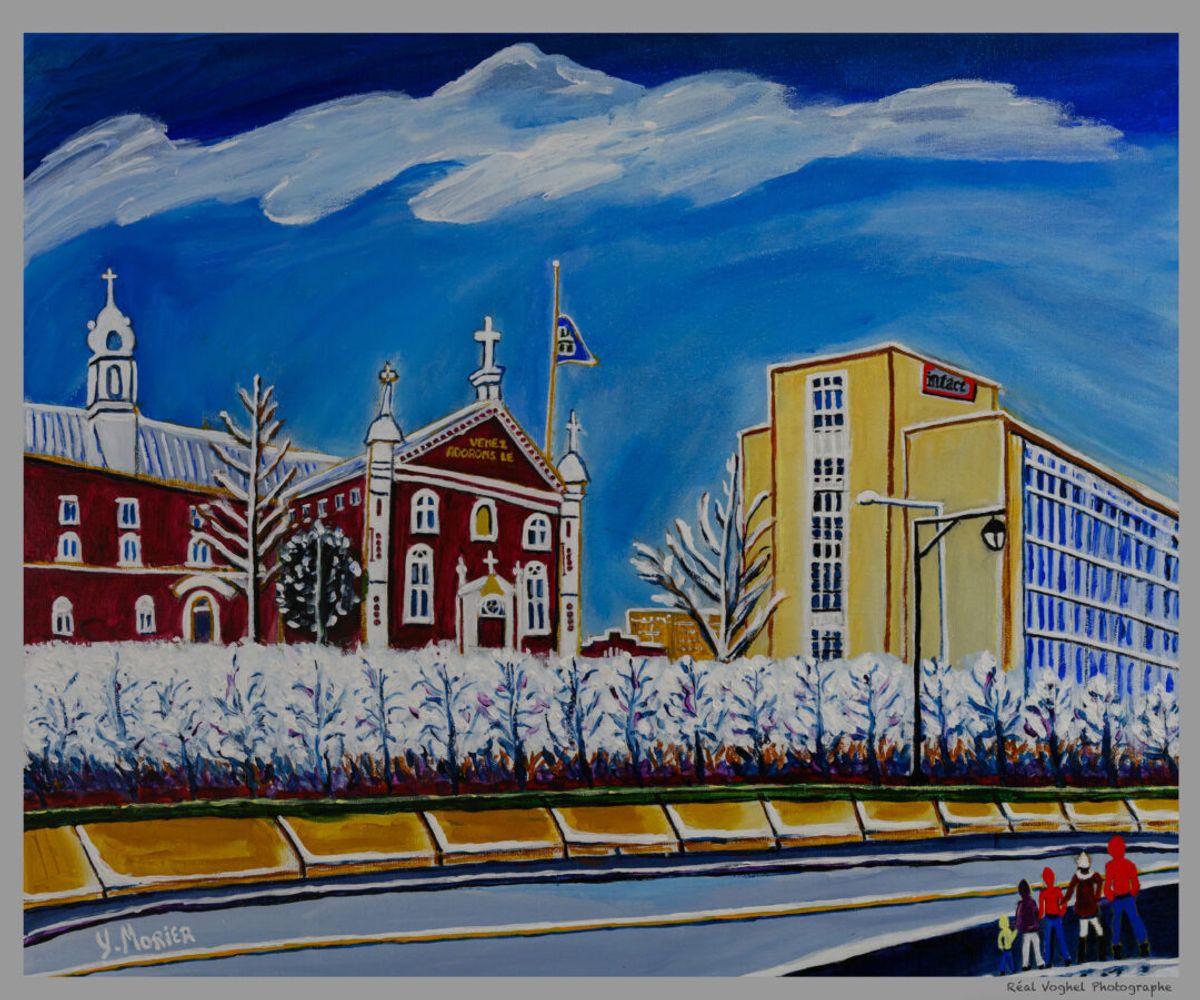
Winter Jolt of April 8, 2025
Acrylic — 20 X 24
- Reference
- 0299
- Year
- 2025
- City
- Saint-Hyacinthe
- Status
- Available
- Support
- Toile galerie
Source of inspiration
My Photos
Chapel of the Sisters Adorers of the Precious Blood of Jesus with its neighbour, the INTACT insurance company.
Based on a photograph taken during my walk early in the morning of April 8, 2025, after freshly fallen snow.
That is why I named this painting: WINTER JOLT.
Painting on exhibit in Paris from November 23 to 25, 2025.
Story
It was while out walking on the morning of April 8, 2025, that I photographed this scene of fresh light snow covering the hedge along the chapel of the Sisters Adorers of the Precious Blood, who have taken vows of poverty and chastity.
Curiously, on this day of WINTER JOLT, the painting shows this magnificent, sober little chapel and, right beside it, the imposing building of the INTACT corporation, a company whose origins go back to 1809, the largest provider of property and casualty insurance in Canada, one of the leading providers of specialty insurance in North America and, with RSA, a leader in the United Kingdom and Ireland, with annual premiums now said to exceed 22 billion dollars.
The religious community of the Sisters Adorers of the Precious Blood was founded in Saint-Hyacinthe on September 14, 1861, by Aurélie Caouette and Bishop Joseph Larocque, then bishop of Saint-Hyacinthe.
The founding of the community is tied to the devotion to the Blood of Christ, which intensified from 1849, the year Pope Pius IX decreed the feast of the Precious Blood.
Devoted to prayer and adoration, the Sisters Adorers of the Precious Blood form the first contemplative community in Canada.
It was at the suggestion of the Bishop of Montreal, Ignace Bourget, and with the support of Joseph-Sabin Raymond, superior of the Séminaire de Saint-Hyacinthe, that Aurélie Caouette founded the community. For some years she had shown great fervour for the Blood of Christ.
Euphrasie Caouette, Elizabeth Hamilton and Sophie Raymond joined her, and they settled in the Caouette family home in Saint-Hyacinthe.
In 1863, the Sisters Adorers of the Precious Blood moved into their own monastery in the same town. Aurélie Caouette then became superior of the community and took the name Mother Catherine-Aurélie of the Precious Blood.
Three years later, a new monastery was built to meet the needs of the growing community.
Under their foundress, the Sisters Adorers of the Precious Blood founded monasteries in Toronto (1869), Montreal (1874), Trois-Rivières (1889), Brooklyn (New York, 1890), Portland (Oregon, 1892), Sherbrooke (1895), Nicolet (1896), Manchester (New Hampshire, 1898) and Havana (Cuba, 1902).
The Sisters Adorers of the Precious Blood are also present in Lévis (1906), Joliette (1907), Mont-Laurier (1934) and Chambly (1991), as well as in Western Canada (1918), Prince Edward Island (1929), China (1924), Italy (1925) and Japan (1934).
By 2018, only 31 Sisters Adorers of the Precious Blood remained in Saint-Hyacinthe, aged 68 to 98.
That was all that remained of the French-speaking branch of a community which, in its golden age, counted no fewer than 42 convents, French- and English-speaking together.
In the latter camp, in 2018, there were still four in English Canada, four in the United States and two in Japan, where a few postulants still came forward.
With no one to take over, the congregation had no choice but to face the facts and contemplate closing its immense monastery.
It was in this spirit that, in 2012, the Adorers agreed to cede their properties on rue Girouard to the City of Saint-Hyacinthe for $500,000; the City intends to make them the cornerstone of its cultural hub, converting the chapel into an exhibition and concert hall and transforming the monastery to house the Centre d’histoire et d’archives de Saint-Hyacinthe.
This magnificent chapel holds more than 36 works of religious art, 16 of them by the painter-decorator Joseph-Thomas Rousseau (1852-1896), who left many works in the churches and convents of the Saint-Hyacinthe region and elsewhere in the province of Quebec.
One of his works, his MATER DOLOROSA, is at the Musée national des beaux-arts du Québec.
It is worth reading the story of Mother Catherine-Aurélie of the Most Precious Blood (1833-1905), Aurélie Caouette, born in Saint-Hyacinthe, a Canadian nun and mystic known for founding the congregation of the Adorers of the Precious Blood.
In 1993, the Diocese of Saint-Hyacinthe opened a diocesan inquiry with a view to her beatification, which was forwarded to the Congregation for the Causes of Saints in 2001.
On December 1, 2001, Pope Francis recognized the heroic nature of her virtues and granted her the title of Venerable.