
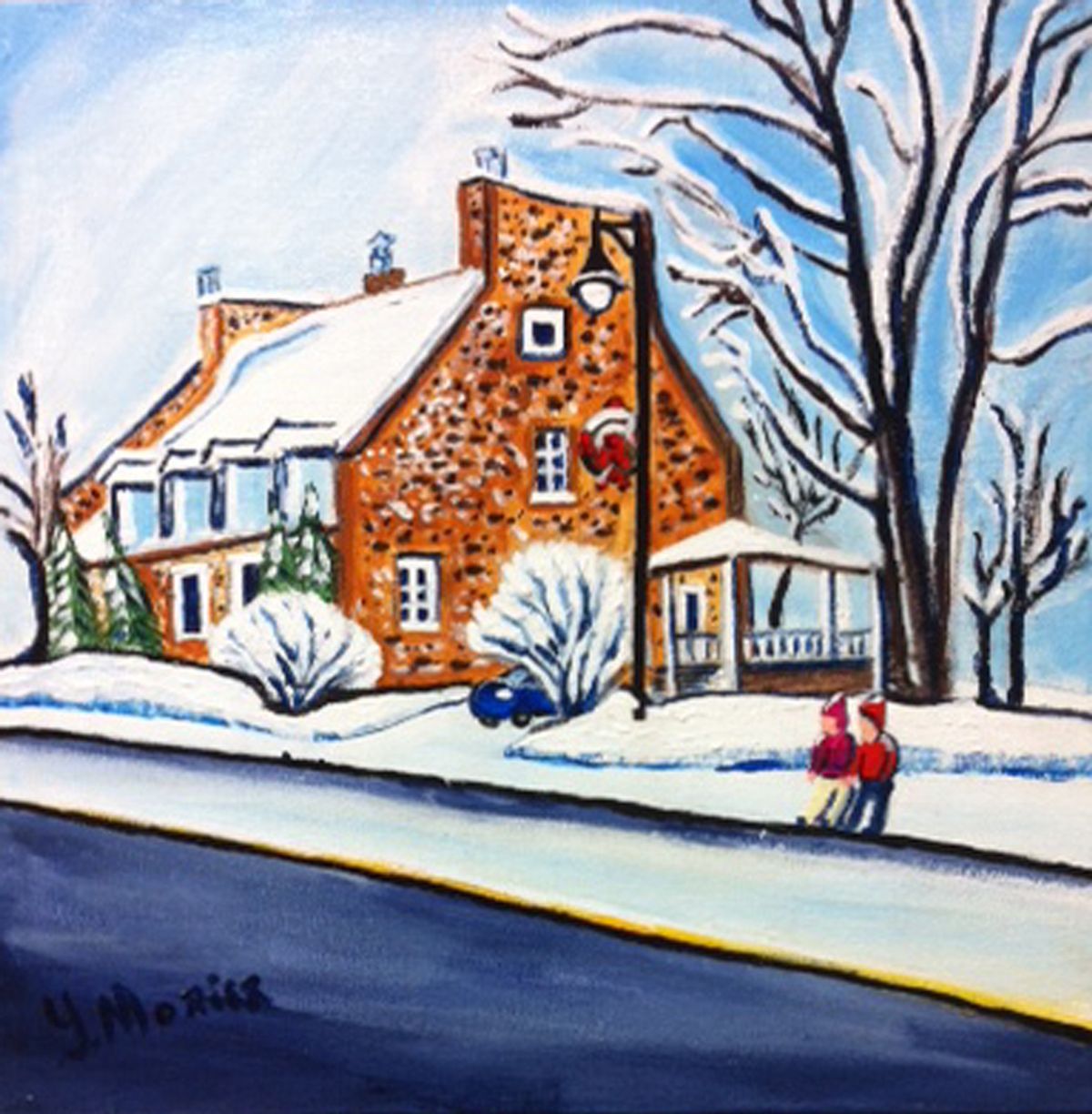
Maison François Cherrier, Saint-Denis-sur-Richelieu
Acrylic — 12 X 12
- Reference
- 0240
- Year
- 2016
- Location
- 639 Chemin des Patriotes
- Status
- Sold
Painting sold on September 22, 2022 at an opening at the galerie le 1855...
Story
Superb heritage house located at 639 Chemin des Patriotes,
Saint-Denis sur-Richelieu. Named in memory of François (1745-1809), son of François-Pierre Cherrier (September 3, 1717-July 21, 1793). This house is believed to have been built between 1808 and 1811. Classified in 2012 as a historic site of inestimable value.
François Pierre Cherrier was born in Savigné-L’Évesque, in Sarthe.
He arrived in 1736 at Saint-Antoine-de-Longueuil in New France, where his uncle was the parish priest.
There he opened a shop and became notary for a seigneurie in 1738.
In 1750, he was appointed royal notary of the parish of Longueuil.
In 1770 he settled in Saint-Denis-sur-Richelieu, where his son François was the parish priest.
He continued to practise as a notary until 1789 and died in Saint-Denis at the age of 75.
His daughter Rosalie Cherrier married Joseph Papineau, notary surveyor and politician, and was the mother of Louis-Joseph Papineau, the very man who would become leader of the Patriotes, and of Rosalie Papineau-Dessaulles, who was a year and a half younger than her brother Louis-Joseph Papineau.
Rosalie Päpineau (born in Montréal on February 27, 1788) met Jean Dessaulles, 22 years her senior, and they married on February 21, 1816 at the église Notre-Dame de Montréal.
The couple settled in the seigneurial manor at Maska, at the spot where today one finds the parc Casimir-Dessaulles, named in honour of their son Georges-Casimir, born in 1827, who would be mayor of the Ville de Saint-Hyacinthe from 1868 to 1870 and from
1886 to 1897.
South of this park, at the corner of rue Girouard ouest and avenue Du Palais, one can see a marking on the ground that shows
the exact location of the seigneurial manor which was demolished in 1876.
Rosalie Papineau-Dessaulles took a very active part in the development of the seigneurie of Maska, which would become the Ville de Saint-Hyacinthe.
She gave her own clothing to help needy women and was nicknamed: La Providence des pauvres. She was the first president of the Comité des dames de la charité, which she herself had founded.
A fervent admirer of her elder brother, Louis-Joseph Papineau,
she supported him in his efforts to obtain better conditions for the French Canadians. During the events of 1837-1838, she supported the rebels as best she could, providing them with food or sheltering them at the manor, even though she knew she was suspected by the English authorities.
It was there that Louis-Joseph Papineau took refuge, after leaving Montréal on November 16, 1837, before leaving the country to exile himself in the United States, then in France, from where he would not return until 1845.
Rosalie passed away in her manor 12 years later, on August 3, 1857, at the age of 69 years, 4 months and 5 days.
She was buried under the seigneurial pew in the chapelle cathédrale de Saint-Hyacinthe.
The small town of Sainte-Rosalie, annexed to Saint-Hyacinthe in 2002, had been named in her honour (1788-1857).
The present-day avenue de l’Hôtel-de Ville in Saint-Hyacinthe once bore the name rue Rosalie in honour of the seigneuresse Rosalie Papineau-Dessaulles.
Her husband Jean Dessaulles had become the new Seigneur of the seigneurie of Maska after inheriting 5/8ths of it, in March 1814, following the death of the founder’s son, Hyacinthe-Marie Delorme, who died prematurely at 36, unmarried and without descendants.
And so the origins of the Ville de Saint-Hyacinthe hold a close connection with this Maison François Cherrier, so well preserved in the magnificent village of Saint-Denis-sur-le-Richelieu.